
Updated October 17, 2026
On October 16, 2026, Immigration, Refugees and Citizenship Canada (IRCC) announced major changes to how Express Entry candidates are scored. Starting November 3, 2026, candidates can earn extra Comprehensive Ranking System (CRS) points for Canadian work experience or a job offer in a high-wage occupation, and job offers will no longer need a Labour Market Impact Assessment (LMIA).
Here is what is changing, how many points each occupation level is worth, and the full list of eligible occupations.
Key changes at a glance
- New “Labour Market Integration” factor in the CRS, worth up to 150 points.
- Extra points for Canadian work experience in a high-wage occupation: 70, 40 or 20 points, on top of the existing points for length of experience.
- Job offer points are back, but only for jobs in high-wage occupations: 100, 70 or 50 points.
- No LMIA needed for a job offer to count for CRS points or for Federal Skilled Worker and Federal Skilled Trades eligibility.
- Existing profiles will be recalculated automatically. This may take up to two weeks, and IRCC will pause invitation rounds during that time.
What is a high-wage occupation?
For Express Entry, an occupation is “high-wage” if the median wage of everyone in Canada working in that National Occupational Classification (NOC) code is at least 1.3 times the median wage of the overall Canadian workforce.
This is based on the occupation as a whole, not on your own salary. A software developer earning less than average still counts as working in a high-wage occupation, and a well-paid worker in an occupation that is not on the list does not.
IRCC groups high-wage occupations into three levels:
| Level | Median wage of the occupation | Number of occupations |
|---|---|---|
| Level 1 | At least 2 times the national median | 31 |
| Level 2 | At least 1.5 times, but less than 2 times | 89 |
| Level 3 | At least 1.3 times, but less than 1.5 times | 66 |
The list uses Job Bank, Labour Force Survey and Census of Population wage data from the previous three years (currently 2023 to 2025). Each occupation is placed at the highest level it reached in any of those years. IRCC will update the list over time, but if it changes after you receive an Invitation to Apply (ITA), the level that applied on the date you were invited is kept.
Note: “Level 1, 2 and 3” are our labels to make the tables easier to read. IRCC describes the levels by their wage thresholds.
CRS points by occupation level
The new Labour Market Integration factor includes points for either:
- your Canadian work experience, based on how long you worked, with extra points for work in eligible high-wage occupations, or
- a qualifying job offer in an eligible high-wage occupation.
You can receive points for one or the other, not both. IRCC compares the two and gives you whichever is higher, up to a maximum of 150 points.
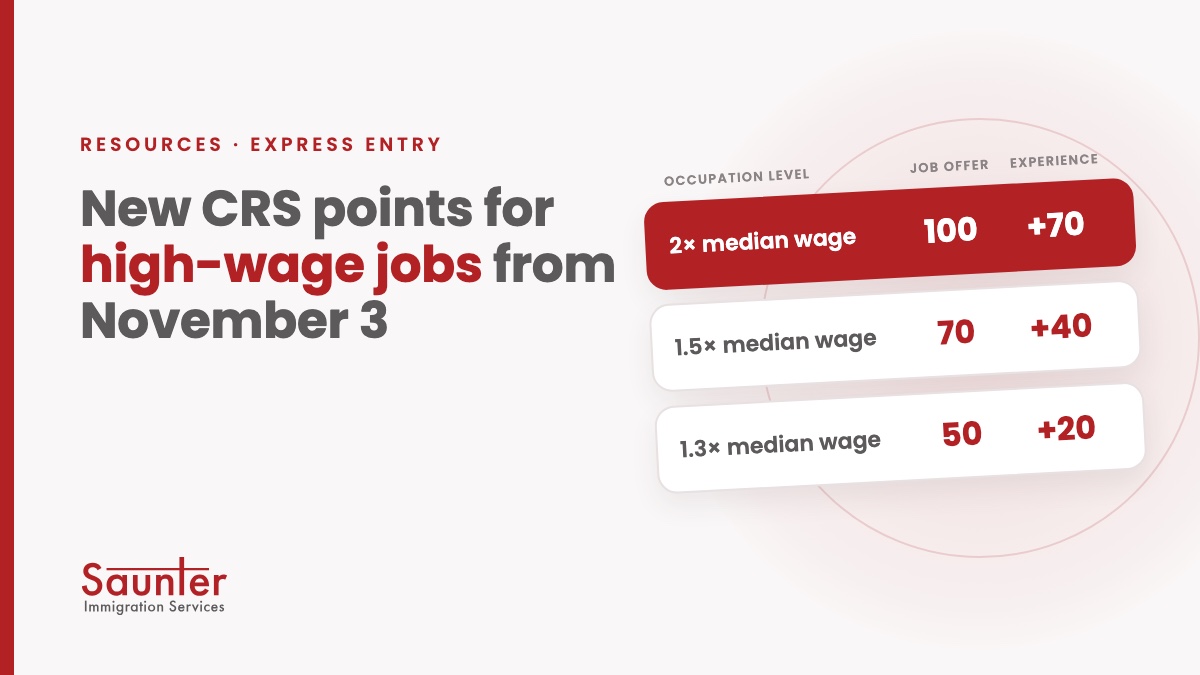
| Occupation level | Extra points for 12+ months of Canadian work experience | Points for a qualifying job offer |
|---|---|---|
| Level 1 (2× median wage) | +70 | 100 |
| Level 2 (1.5× median wage) | +40 | 70 |
| Level 3 (1.3× median wage) | +20 | 50 |
| Not a high-wage occupation | 0 | 0 |
Points for Canadian work experience
Canadian work experience points have two parts: the work-length points you already receive today, plus the new high-wage points.
1. Work-length points (unchanged) for qualifying experience in any TEER 0, 1, 2 or 3 occupation:
| Canadian work experience | With a spouse or common-law partner | Without a spouse or common-law partner |
|---|---|---|
| Less than 1 year | 0 | 0 |
| 1 year | 35 | 40 |
| 2 years | 46 | 53 |
| 3 years | 56 | 64 |
| 4 years | 63 | 72 |
| 5 years or more | 70 | 80 |
2. High-wage points (new), added on top, if you have at least 12 months (1,560 hours) of qualifying Canadian work experience in high-wage occupations:
| Qualifying Canadian work experience | Extra points |
|---|---|
| At least 12 months in one or more Level 1 occupations | 70 |
| Otherwise, at least 12 months combined in Level 1 or Level 2 occupations | 40 |
| Otherwise, at least 12 months combined in any high-wage occupations | 20 |
| Less than 12 months in high-wage occupations | 0 |
The 12 months can be continuous or not, full-time or an equal amount of part-time work, and combined across more than one high-wage job. If you held two jobs at once, hours count only up to the full-time equivalent of 30 hours a week. The usual rules for qualifying Canadian work experience still apply, including that it must be in a TEER 0, 1, 2 or 3 occupation.
| Maximum Canadian work experience points | With a spouse or common-law partner | Without a spouse or common-law partner |
|---|---|---|
| Work-length points | 70 | 80 |
| High-wage points | 70 | 70 |
| Total | 140 | 150 |
Points for a job offer
Job offer points, which were removed from the CRS in 2025, are coming back, but only for jobs in high-wage occupations. The points depend on the occupation’s level, not on the salary in your offer:
| Job offer | Points |
|---|---|
| In a Level 1 occupation (2× median wage) | 100 |
| In a Level 2 occupation (1.5× median wage) | 70 |
| In a Level 3 occupation (1.3× median wage) | 50 |
| Not in a high-wage occupation | 0 |
The offer must be valid under Express Entry. Generally, that means a written offer of full-time, continuous, paid work in Canada for at least one year after you become a permanent resident.
Examples
- Priya (no spouse) has 3 years of Canadian experience as a software developer (NOC 21232, Level 2). She gets 64 work-length points + 40 high-wage points = 104 points.
- Marco (with a spouse) has 1 year of Canadian experience as an industrial electrician (NOC 72201, Level 3). He gets 35 + 20 = 55 points. A job offer in the same occupation would be worth 50, so his experience points are used.
- Ana (no spouse) has 1 year of Canadian experience in an occupation that is not on the list, and a job offer as an engineering manager (NOC 20010, Level 1). Her experience is worth 40 points and the job offer 100, so she receives 100 points.
These examples show only the Labour Market Integration points. Your total CRS score also includes age, education, language, skill transferability and any additional points.
No more LMIA for job offers
From November 3, 2026, a job offer does not need an LMIA to count for CRS points or to meet the job offer requirements of the Federal Skilled Worker and Federal Skilled Trades programs. Having an LMIA will not give you extra points or priority. The offer can be for a new or existing position, with a new or current employer.
IRCC will still check every job offer when you apply for permanent residence. An officer must be satisfied that the offer is genuine, including that the employer is actively operating, can meet the terms of the offer, has a real need for the position and follows employment and recruitment laws, and that you are qualified and likely to accept the job.
Program eligibility is assessed separately from CRS points. A valid job offer in any TEER 0, 1, 2 or 3 occupation can still help you qualify for the Federal Skilled Worker or Federal Skilled Trades program, even if it is not a high-wage occupation and earns no CRS points.
If you are already in the Express Entry pool
- Your score will be recalculated automatically on November 3, including the new points for Canadian work experience.
- If you have a job offer that is not in your profile, update your profile before November 3, 2026.
- Invitation rounds will pause for up to two weeks while IRCC recalculates profiles.
- IRCC’s online profile form will not change right away. Until it does, IRCC asks candidates with a job offer but no LMIA to answer “Yes” to the LMIA question and enter these placeholder details: LMIA number 00000, issued 2026-01-01, expiring 2029-01-01. See IRCC’s job offer page for the exact steps.
- Check the NOC code for each job in your profile carefully. Points depend entirely on the occupation code, so it must match the duties you actually perform.
Full list of high-wage occupations
Below are all 186 occupations on IRCC’s list that takes effect on November 3, 2026. You can look up your NOC code with the National Occupational Classification search tool.
Level 1: at least 2 times the median wage (31 occupations)
100 job offer points · +70 Canadian experience points
| NOC code | Occupation |
|---|---|
| 00011 | Senior government managers and officials |
| 00012 | Senior managers – financial, communications and other business services |
| 00013 | Senior managers – health, education, social and community services and membership organizations |
| 10010 | Financial managers |
| 10011 | Human resources managers |
| 10012 | Purchasing managers |
| 10020 | Insurance, real estate and financial brokerage managers |
| 10021 | Banking, credit and other investment managers |
| 20010 | Engineering managers |
| 20011 | Architecture and science managers |
| 20012 | Computer and information systems managers |
| 21330 | Mining engineers |
| 21332 | Petroleum engineers |
| 31100 | Specialists in clinical and laboratory medicine |
| 31101 | Specialists in surgery |
| 31102 | General practitioners and family physicians |
| 31103 | Veterinarians |
| 31302 | Nurse practitioners |
| 31303 | Physician assistants, midwives and allied health professionals |
| 40010 | Government managers – health and social policy development and program administration |
| 40011 | Government managers – economic analysis, policy development and program administration |
| 40012 | Government managers – education policy development and program administration |
| 40019 | Other managers in public administration |
| 40040 | Commissioned police officers and related occupations in public protection services |
| 40041 | Fire chiefs and senior firefighting officers |
| 41100 | Judges |
| 41101 | Lawyers and Quebec notaries |
| 41200 | University professors and lecturers |
| 60010 | Corporate sales managers |
| 80010 | Managers in natural resources production and fishing |
| 90011 | Utilities managers |
Level 2: at least 1.5 times the median wage (89 occupations)
70 job offer points · +40 Canadian experience points
| NOC code | Occupation |
|---|---|
| 00014 | Senior managers – trade, broadcasting and other services |
| 00015 | Senior managers – construction, transportation, production and utilities |
| 10019 | Other administrative services managers |
| 10022 | Advertising, marketing and public relations managers |
| 10029 | Other business services managers |
| 10030 | Telecommunication carriers managers |
| 11103 | Securities agents, investment dealers and brokers |
| 11201 | Professional occupations in business management consulting |
| 21100 | Physicists and astronomers |
| 21102 | Geoscientists and oceanographers |
| 21103 | Meteorologists and climatologists |
| 21109 | Other professional occupations in physical sciences |
| 21111 | Forestry professionals |
| 21120 | Public and environmental health and safety professionals |
| 21202 | Urban and land use planners |
| 21210 | Mathematicians, statisticians and actuaries |
| 21211 | Data scientists |
| 21220 | Cybersecurity specialists |
| 21221 | Business systems specialists |
| 21222 | Information systems specialists |
| 21223 | Database analysts and data administrators |
| 21230 | Computer systems developers and programmers |
| 21231 | Software engineers and designers |
| 21232 | Software developers and programmers |
| 21300 | Civil engineers |
| 21301 | Mechanical engineers |
| 21310 | Electrical and electronics engineers |
| 21311 | Computer engineers (except software engineers and designers) |
| 21320 | Chemical engineers |
| 21321 | Industrial and manufacturing engineers |
| 21322 | Metallurgical and materials engineers |
| 21331 | Geological engineers |
| 21390 | Aerospace engineers |
| 21399 | Other professional engineers |
| 22231 | Engineering inspectors and regulatory officers |
| 22312 | Industrial instrument technicians and mechanics |
| 30010 | Managers in health care |
| 31110 | Dentists |
| 31112 | Audiologists and speech-language pathologists |
| 31120 | Pharmacists |
| 31200 | Psychologists |
| 31202 | Physiotherapists |
| 31203 | Occupational therapists |
| 31300 | Nursing coordinators and supervisors |
| 31301 | Registered nurses and registered psychiatric nurses |
| 32111 | Dental hygienists and dental therapists |
| 40020 | Administrators – post-secondary education and vocational training |
| 40021 | School principals and administrators of elementary and secondary education |
| 40030 | Managers in social, community and correctional services |
| 40042 | Commissioned officers of the Canadian Armed Forces |
| 41210 | College and other vocational instructors |
| 41220 | Secondary school teachers |
| 41221 | Elementary school and kindergarten teachers |
| 41310 | Police investigators and other investigative occupations |
| 41311 | Probation and parole officers |
| 41320 | Educational counsellors |
| 41401 | Economists and economic policy researchers and analysts |
| 41402 | Business development officers and market researchers and analysts |
| 41404 | Health policy researchers, consultants and program officers |
| 41407 | Program officers unique to government |
| 42100 | Police officers (except commissioned) |
| 42101 | Firefighters |
| 50010 | Library, archive, museum and art gallery managers |
| 50011 | Managers – publishing, motion pictures, broadcasting and performing arts |
| 51100 | Librarians |
| 70010 | Construction managers |
| 70012 | Facility operation and maintenance managers |
| 70020 | Managers in transportation |
| 70021 | Postal and courier services managers |
| 72011 | Contractors and supervisors, electrical trades and telecommunications occupations |
| 72012 | Contractors and supervisors, pipefitting trades |
| 72023 | Supervisors, railway transport operations |
| 72103 | Boilermakers |
| 72202 | Power system electricians |
| 72203 | Electrical power line and cable workers |
| 72301 | Steamfitters, pipefitters and sprinkler system installers |
| 72406 | Elevator constructors and mechanics |
| 72600 | Air pilots, flight engineers and flying instructors |
| 72601 | Air traffic controllers and related occupations |
| 72604 | Railway traffic controllers and marine traffic regulators |
| 73310 | Railway and yard locomotive engineers |
| 82020 | Supervisors, mining and quarrying |
| 82021 | Contractors and supervisors, oil and gas drilling and services |
| 83101 | Oil and gas well drillers, servicers, testers and related workers |
| 90010 | Manufacturing managers |
| 92011 | Supervisors, petroleum, gas and chemical processing and utilities |
| 92100 | Power engineers and power systems operators |
| 93100 | Central control and process operators, mineral and metal processing |
| 93101 | Central control and process operators, petroleum, gas and chemical processing |
Level 3: at least 1.3 times the median wage (66 occupations)
50 job offer points · +20 Canadian experience points
| NOC code | Occupation |
|---|---|
| 00010 | Legislators |
| 11100 | Financial auditors and accountants |
| 11101 | Financial and investment analysts |
| 11102 | Financial advisors |
| 11109 | Other financial officers |
| 11200 | Human resources professionals |
| 12201 | Insurance adjusters and claims examiners |
| 12203 | Assessors, business valuators and appraisers |
| 21101 | Chemists |
| 21110 | Biologists and related scientists |
| 21112 | Agricultural representatives, consultants and specialists |
| 21200 | Architects |
| 21201 | Landscape architects |
| 21203 | Land surveyors |
| 21234 | Web developers and programmers |
| 22214 | Technical occupations in geomatics and meteorology |
| 22232 | Occupational health and safety specialists |
| 22233 | Construction inspectors |
| 22310 | Electrical and electronics engineering technologists and technicians |
| 22313 | Aircraft instrument, electrical and avionics mechanics, technicians and inspectors |
| 31121 | Dietitians and nutritionists |
| 32102 | Paramedical occupations |
| 32103 | Respiratory therapists, clinical perfusionists and cardiopulmonary technologists |
| 32120 | Medical laboratory technologists |
| 32121 | Medical radiation technologists |
| 32122 | Medical sonographers |
| 41300 | Social workers |
| 41400 | Natural and applied science policy researchers, consultants and program officers |
| 41403 | Social policy researchers, consultants and program officers |
| 41405 | Education policy researchers, consultants and program officers |
| 41409 | Other professional occupations in social science |
| 43201 | Correctional service officers |
| 43203 | Border services, customs, and immigration officers |
| 50012 | Recreation, sports and fitness program and service directors |
| 51101 | Conservators and curators |
| 51102 | Archivists |
| 51111 | Authors and writers (except technical) |
| 51112 | Technical writers |
| 51120 | Producers, directors, choreographers and related occupations |
| 52112 | Broadcast technicians |
| 60020 | Retail and wholesale trade managers |
| 60031 | Accommodation service managers |
| 60040 | Managers in customer and personal services |
| 72010 | Contractors and supervisors, machining, metal forming, shaping and erecting trades and related occupations |
| 72013 | Contractors and supervisors, carpentry trades |
| 72014 | Contractors and supervisors, other construction trades, installers, repairers and servicers |
| 72020 | Contractors and supervisors, mechanic trades |
| 72021 | Contractors and supervisors, heavy equipment operator crews |
| 72102 | Sheet metal workers |
| 72105 | Ironworkers |
| 72201 | Industrial electricians |
| 72302 | Gas fitters |
| 72320 | Bricklayers |
| 72321 | Insulators |
| 72401 | Heavy-duty equipment mechanics |
| 72403 | Railway carmen/women |
| 72404 | Aircraft mechanics and aircraft inspectors |
| 72500 | Crane operators |
| 72602 | Deck officers, water transport |
| 72603 | Engineer officers, water transport |
| 73311 | Railway conductors and brakemen/women |
| 82010 | Supervisors, logging and forestry |
| 83100 | Underground production and development miners |
| 83120 | Fishing masters and officers |
| 92010 | Supervisors, mineral and metal processing |
| 93102 | Pulping, papermaking and coating control operators |
What this means for you
- Check whether your occupation is on the list. If you have at least a year of Canadian experience in a high-wage occupation, your score could rise by 20 to 70 points.
- A job offer matters again, but only in a high-wage occupation. Offers outside the list can still help with program eligibility but give no CRS points.
- Cut-off scores may change. Many candidates will gain points at the same time, so past cut-offs may not be a good guide to the first draws after November 3.
Important to know
This article is based on IRCC’s announcement and program pages published on October 16, 2026. Details may change, and no one can guarantee an invitation. Always check IRCC’s What has changed in Express Entry page and the official high-wage occupations list before updating your profile.
Not sure how these changes affect your score? Book a consultation, and we’ll review your profile, your NOC codes and any job offers, and explain the options that may fit you.
Sources: IRCC news release: Canada refocusing Express Entry on top talent that drives economic growth; IRCC: 2026 changes to points for Canadian work experience and job offers; IRCC: High-wage occupations and how we assess them; IRCC: Express Entry job offer. Figures as of October 16, 2026.